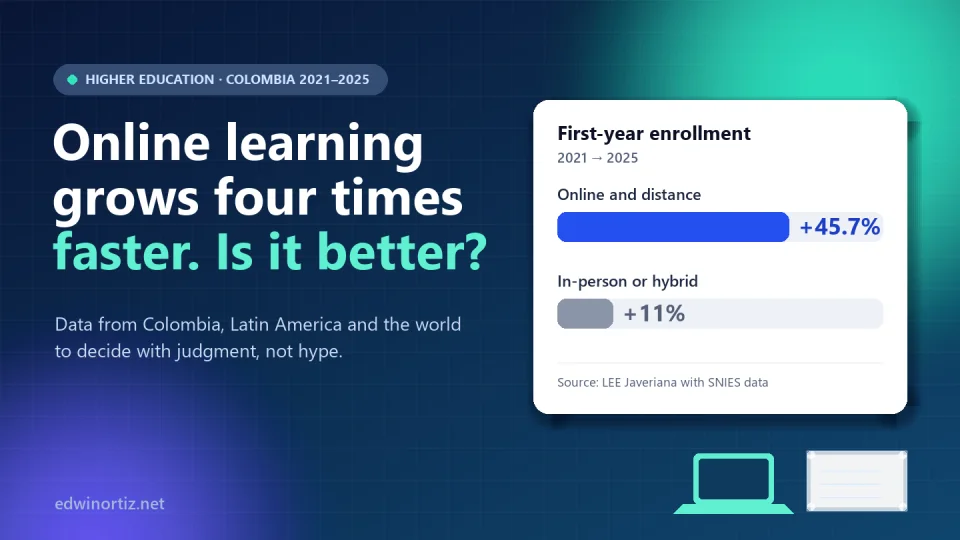
In 2020 I taught over WhatsApp, through phone calls that kept dropping and with printed worksheets that families picked up at the school gate. I learned a lot, and I also watched many students vanish from the roll while nobody could do much about it; I wrote about it that April in an article on online schooling in Colombian public schools (in Spanish). So when I read that first-year enrollment in online and distance programs grew 45% between 2021 and 2025, versus 11% for in-person programs, I neither celebrated nor mourned. I asked myself the question I want to answer here with data: does growing faster mean being better?
My short answer is no, but it doesn’t mean being worse either. The format matters less than the quality with which a program is designed, supported and assessed. Still, the evidence in favor of the in-person classroom exists, it is serious, and it deserves a hard look before enrolling a child, launching a program or changing the way we teach.
First, let’s verify the figure
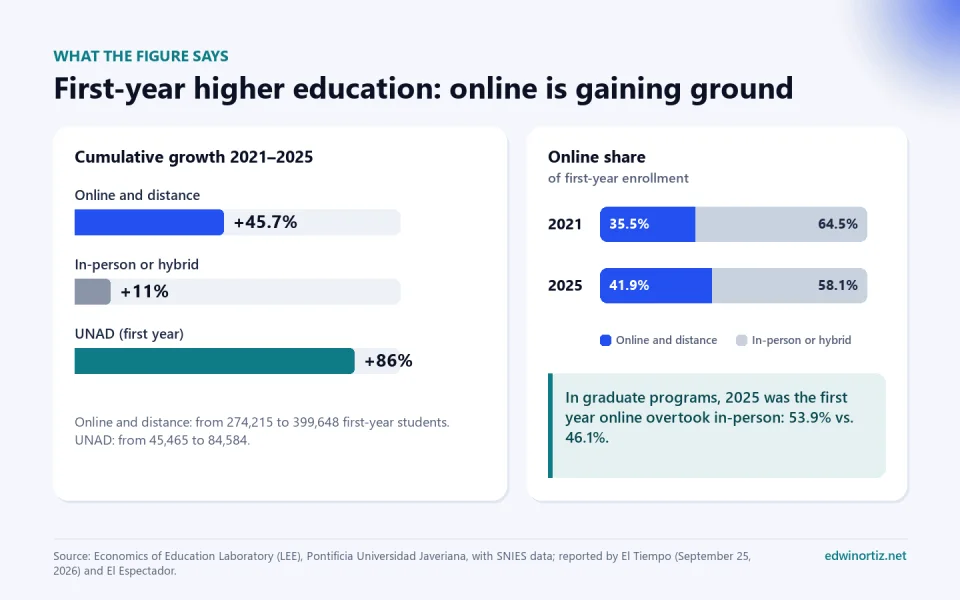
The figure is real, but it needs to be read precisely. It comes from an analysis by the Economics of Education Laboratory (LEE) at Pontificia Universidad Javeriana using official data from Colombia’s National Higher Education Information System (SNIES), reported by El Tiempo on September 25, 2026 and by El Espectador. At the time of writing I could not find the full report on the LEE website, so I cite what those two newspapers report from the study.
| Indicator (higher education, Colombia) | Data |
|---|---|
| First-year students in online and distance programs | From 274,215 in 2021 to 399,648 in 2025: +45.7% |
| First-year students in in-person or hybrid programs | +11% over the same period |
| Online share of first-year enrollment | 35.5% in 2021 and 41.9% in 2025 |
| Graduate programs | In 2025 online overtook in-person for the first time: 53.9% vs. 46.1% |
| UNAD (national open and distance university), first year | From 45,465 to 84,584 students (+86%) |
| Universidad Nacional | Applicants: from 75,681 in 2019 to 39,397 in 2026 (−48%); first-year undergraduates: −7.5% |
| Total higher education enrollment in 2025 | 2,723,364 students, a record |
With that settled, there are three caveats that rarely make it into the headline:
- It’s higher education, not school. It covers technical, technological, university and graduate programs. It says nothing about primary or secondary school.
- It’s first-year students, not graduates. It measures who gets in, not who finishes or how much they learn.
- The comparison is against “in-person or hybrid.” That 11% includes programs that already mix classroom and screen, so the real debate is not “online versus in-person” but how much presence, and of what quality.
And one figure worries me as a teacher: according to El Espectador, between 2021 and 2025 the number of higher education faculty grew 11.9% while enrollment grew about 20%. When students multiply faster than the people who support them, quality is put to the test, in any format.
Why online education is growing
It would be unfair to dismiss this boom as a post-pandemic fad. There are deep reasons, and several of them are good news:
- Territorial access. Many Colombian municipalities have no university campus nearby. For a young farm worker or a single mother, the alternative to online learning is usually not in-person learning: it’s not studying at all.
- Time and cost. Studying without moving, without paying daily transport and on a flexible schedule changes any family’s math.
- Shorter programs. Analyst Ricardo Rodríguez put it this way in El Tiempo: “young people increasingly ask for shorter programs.” SENA, the national training service, already accounts for 66% of first-year enrollment at the technological level.
- Adults going back to school. The jump in online graduate programs, which now outnumber in-person ones, points to professionals upskilling without leaving their jobs.
There are also advocates within institutions who make a solid case. Eduardo Behrentz, in a column in Portafolio (December 2024), argues that a good online program requires “major investments in technology and teacher training” plus pedagogical design, and that it can be an answer to regional inequality. I share the condition he sets himself: quality online learning is neither cheap nor improvised.
The other side: what supports in-person learning
Now the contrast. Those who argue that the in-person classroom is better are not just being nostalgic. This is the strongest evidence I found, from Colombia outward.
Colombia: dropout, quality and the digital divide
Dropout. An analysis by Javeriana’s LEE (June 2020) found that, of the students who started online undergraduate programs in the first semester of 2014, 67% had dropped out by the tenth semester, and that dropout in those programs was twice as high as in face-to-face programs. The same report noted that only 3% of online programs held high-quality accreditation. Those data run only through 2018 and the system has changed since, but I couldn’t find a public update by format with the same clarity. That gap is itself a problem: if a format grows 45%, we should be able to find out just as easily how many of those students finish. For reference, LEE report 74 puts the system’s average annual dropout rate at 11% between 2000 and 2021, rising to 12.7% in the second half of 2020.
What the pandemic left in schools. School closures were emergency remote teaching, not planned online education, but they are the closest mass experience we have. An analysis by three Javeriana professors reported by Semana (March 2021) showed that the gap in overall Saber 11 scores (Colombia’s high school exit exam) between private and public schools widened from 24 points in 2019 to 29.5 in 2020. And in an LEE survey of 4,527 teachers and 905 school leaders from 762 schools, the main reason students didn’t take part was lack of internet, followed by lack of devices.
The digital divide is still there. According to DANE’s 2024 household ICT survey, 65.6% of households have internet, but in villages and dispersed rural areas the figure drops to 41.9%. Worse: only 9.6% of rural households have a computer or tablet, and 45.3% of connected rural households rate their service as “bad.”
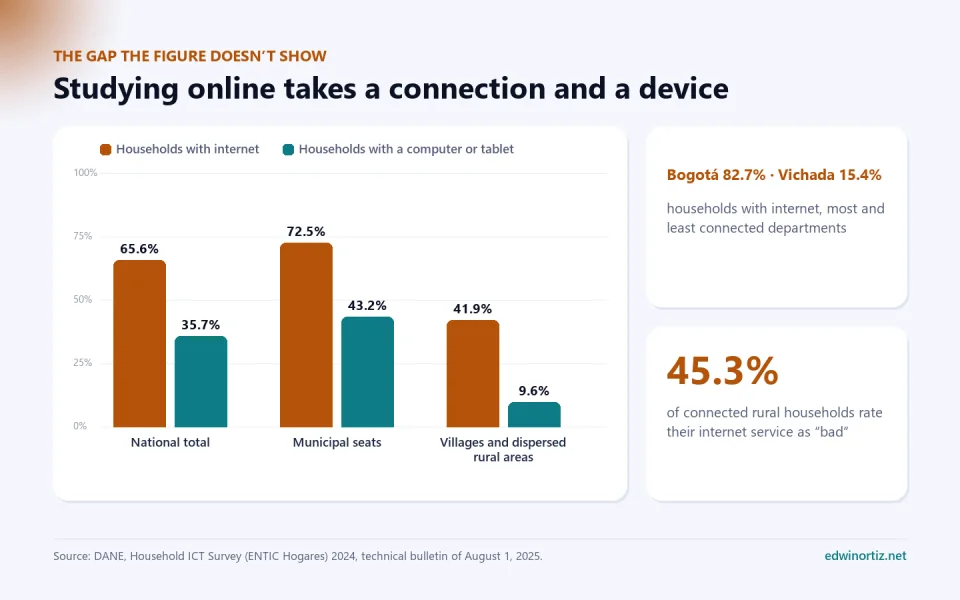
Here lies the Colombian paradox: online learning is defended as the great gateway for the regions, and it is precisely in the regions where conditions for studying online are weakest. Earning a degree from a phone, on prepaid data and with a patchy signal, is not the same as doing it with a computer and fiber.
Latin America: the region that kept classrooms closed the longest
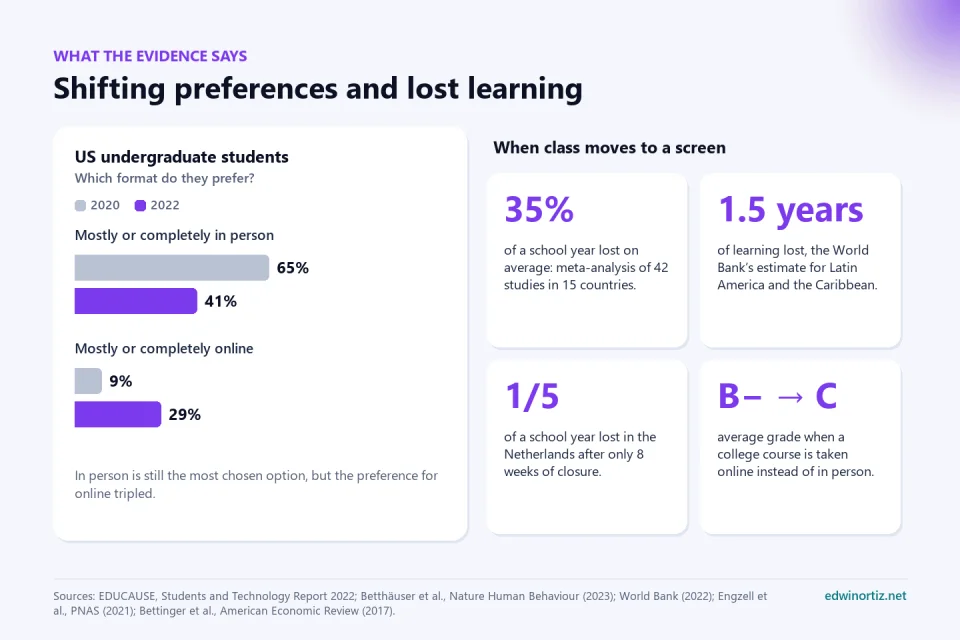
UNICEF documented that two-thirds of the 14 countries with the longest school closures were in Latin America and the Caribbean. The cost appears in the June 2022 report by the World Bank, UNICEF and UNESCO: students lost, partially or completely, two-thirds of in-person school days, with an estimated loss of 1.5 years of learning and a possible 12% drop in lifetime earnings. Note one nuance: according to UNICEF, our region had the widest access to remote learning (only 9% of schoolchildren were left with no option at all). Having access did not guarantee learning.
In higher education, the region is moving in the same direction as Colombia, and Brazil is the most revealing case. According to the INEP census reported by Agência Brasil, in 2024 distance learning already accounted for 50.7% of undergraduate enrollment. And the state reacted: Decree 12,456 of 2025 banned distance delivery for medicine, law, dentistry, nursing and psychology; placed teacher-training degrees in a blended format with up to 50% at a distance; and, as Diário do Nordeste explains, required at least one in-person assessment per course unit and a maximum of 70 students per live class. A country where half of undergraduates already study at a distance decided that training doctors and teachers requires presence.
In Chile, the Undersecretariat of Higher Education reports that distance enrollment at professional institutes grew 111.9% between 2021 and 2025. In Mexico, La Jornada reported that UNAM’s open and distance system has 28.6% more students than a decade ago. The trend is regional; the policy responses, not so much.
The rest of the world: what the most rigorous studies say
- Global meta-analysis. Betthäuser, Bach-Mortensen and Engzell (Nature Human Behaviour, 2023) reviewed 42 studies from 15 countries and estimated a learning deficit of 0.14 standard deviations during the pandemic, about 35% of a school year. It was larger among students from low socioeconomic backgrounds and in middle-income countries like ours.
- Europe. In the Netherlands, with good connectivity and a closure of only eight weeks, Engzell, Frey and Verhagen (PNAS, 2021) measured a loss of three percentile points, one-fifth of a school year, up to 60% larger in less-educated homes.
- United States. The Education Recovery Scorecard from Harvard and Stanford estimated that the average student in grades 3 to 8 lost the equivalent of half a year in math; declines were larger in districts that stayed remote longer and in poorer ones, although the authors caution that format doesn’t explain everything.
- Asia. In India, an Azim Premji University study of 16,067 children found that 92% had lost at least one foundational language ability and 82% at least one in math.
- Online college, outside the pandemic. Bettinger, Fox, Loeb and Taylor (American Economic Review, 2017) compared the same course at a large for-profit university: in person, the average grade was a B−; online, a C. Those who took it online were nine percentage points less likely to remain enrolled, and the blow was bigger for students with weaker prior performance.
UNESCO’s 2023 GEM Report concluded that there is little robust evidence on the added value of technology in education and called for it never to replace in-person, teacher-led instruction. But be careful not to read this as a verdict. The PISA 2022 results showed no clear difference in performance trends between countries with short and long closures; across the OECD, what was most strongly associated with math performance was students having teachers available to help them. Once again, the deciding factor was neither the screen nor the desk: it was support. I discussed this when analyzing PISA results in Latin America.
What do people prefer?
Here the picture is less clear-cut than either side assumes. In the United States, the 2022 EDUCAUSE report showed that undergraduates’ preference for mostly or completely face-to-face courses fell from 65% in 2020 to 41% in 2022, while the preference for online courses rose from 9% to 29%. Reputation matters too: in a Gallup survey, 34% of Americans rated online programs as excellent or good, versus 68% for traditional four-year colleges. That poll is from 2013 and perceptions have shifted; I could not find a recent, verifiable survey on how Colombian employers value an online degree, and I’d rather say so than make up a number.
Three perspectives that should talk to each other
Teachers
Many of us lived emergency online teaching as overload: preparing worksheets, answering messages at eleven at night and chasing students who never logged on. According to the same LEE research, more than a third of the teachers surveyed had between 20 and 40 years of exclusively in-person experience. Yet teachers who now work in well-designed online programs tell a different story: more time for written feedback, reusable materials and highly motivated adult students. The difference is design. An online class is not a filmed in-person class; it needs shorter activities, clearer instructions and assessments built so they can’t be solved by copying. If you’re redesigning your lessons for a hybrid format, the AI Kit for Teachers includes subject-by-subject recipes to prepare worksheets, activities and feedback without giving up your judgment.
Schools, universities and leaders
For an institution, online delivery is an opportunity for reach and also for revenue. That’s where the risk lies: growing enrollment without growing tutors, follow-up and assessment. Colombia’s Decree 1330 of 2019 recognizes in-person, distance, online, dual and combined formats, and requires the same quality conditions of all of them. In Brazil, Education Minister Camilo Santana justified the new decree by the need to “guarantee the quality of teaching,” while INEP president Manuel Palacios noted that distance learning reached students who would otherwise never have entered higher education. Both things are true at once. A responsible leader should look less at the number of sign-ups and more at the number of students still active in week four. Something as simple as a well-kept attendance sheet in Excel, in person or online, already works as an early dropout warning.
Families
Parents lived online schooling from the kitchen table. In a survey by the research center Ceinfes of 19,040 people in 30 Colombian departments, reported by Radio Nacional in August 2020, 76% of parents named connectivity as one of the biggest difficulties, and only 10% of secondary students felt they learned more online. For a 15-year-old, in-person school means learning, friendship, food and protection, not just content. But when that same child turns 25, has a job and wants a technology degree, the same family may see online learning as their only chance. Families aren’t against online learning: they’re against the kind that leaves them on their own.
Where online learning does work
It would be dishonest to present only the evidence against. The US Department of Education meta-analysis (2009, revised in 2010) found that students in online conditions performed modestly better on average than those in face-to-face instruction, with a clearer advantage in blended models. The authors themselves caution that those programs often provided more time and more resources, so it isn’t the screen that does the teaching. In the United States, according to the NCES, 28% of undergraduates studied exclusively at a distance in fall 2021, up from 15% in 2019.
Taken together, the evidence draws a fairly clear profile. Online learning tends to work best with:
- adult students with study habits and clear goals;
- graduate programs and professional upskilling;
- programs with active tutoring, live sessions and serious assessment;
- contexts where the real alternative is not studying at all.
And it tends to fail with very young students, students with gaps in the basics, without a stable connection or without someone to support them. In the Bettinger study, students with strong prior performance were barely affected; those who were already struggling lost about half a letter grade. Online learning widens opportunities, but it can also widen inequalities.
My position: the question isn’t the format, it’s the quality
After reviewing the data, I don’t believe in-person learning is better by definition, nor that online learning is the inevitable future. I believe the in-person classroom has advantages that are hard to replace for children and teenagers, in programs with intensive hands-on practice and for students who need more support. And I believe well-designed online learning is a valuable tool for territorial fairness for adults who can’t leave their town. The sensible path for most is intentional hybrid learning: presence where it matters, screens where they help.
If you’re choosing an online program, for yourself or for your child, these are the questions I’d ask before paying tuition:
- Does it have a valid qualified registration in SNIES and, better still, high-quality accreditation?
- How many students does each tutor have, and how fast do they respond?
- Are there live sessions, or is it all self-paced?
- Are assessments serious, with some in-person or supervised component?
- How many of those who start actually finish? If the institution doesn’t know or won’t say, that is an answer.
- Do I have the equipment, the connection and the real hours to study every week?
And to teachers, a practical suggestion: in any format, assessment is the most visible weak spot. An identical exam for everyone, sent by email, gets solved in a group chat within minutes. That’s why I built the AI Exam Generator, which creates several versions of the same exam with an answer key; you can try it for free in the demo. And if your class includes students with disabilities, remember that online flexibility doesn’t replace reasonable accommodations: PIAR with AI helps you build the individual plan, and the first one is free.
Tools to teach well in the classroom or on screen. The AI Kit for Teachers includes tested recipes by subject, aligned with the Colombian curriculum, for 60,000 Colombian pesos per subject. The AI Exam Generator creates different versions of the same exam, with plans from 29,900 pesos. PIAR with AI lets you build one PIAR for free and then choose packages of 5, 10 or 20 plans. And if you’re preparing for Colombia’s teacher selection exam, the free practice test lets you measure yourself online, at your own pace. None of them replaces your presence: they’re built so you can spend it where it matters.
Food for thought
Online learning is growing fastest precisely among those with the fewest options, while Brazil, where half of undergraduates already study at a distance, is starting to require presence to train doctors and teachers. A young person in Vichada, where only 15 in 100 households have internet, may only be able to study online; another in Bogotá chooses in-person because they can afford the bus fare, the library and the time. If we accept that the in-person classroom educates better in certain cases, are we willing to guarantee it for those who live far away too, or will we end up with a two-speed system in which presence becomes a privilege and the screen a consolation prize?
Was this article helpful?
React and share it with someone who might find it useful.
- Like 0
- Insightful 0
- Celebrate 0
- Love 0
- Thought-provoking 0
Prefer to have it ready?
More guides in AI and technology for teachers