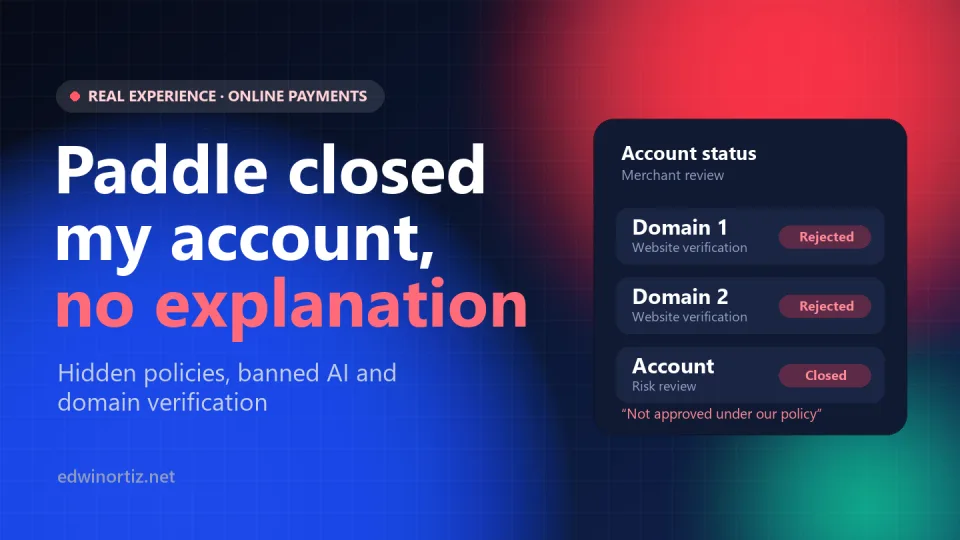
If you sell software from Colombia or any other Latin American country and someone recommended Paddle to you as the solution for getting paid worldwide, read this before you create your account. Just as I did with Mercado Pago, which rejected my large payments, and with Wompi, Bancolombia’s payment gateway, and its limits (in Spanish), here I’ll tell you what I went through with Paddle, why I think it happens, what it does well and what you should ask before investing time in integrating it.
This isn’t a sponsored review or a cheap shot. It’s the experience of someone who creates educational software, tried to use Paddle to sell it and ended up with the account permanently closed, without a concrete explanation and with no possibility of trying again.
Why Paddle seems like the perfect option for selling software
Paddle isn’t a traditional payment gateway. It works as a “Merchant of Record”: technically, Paddle sells your product to the customer and then pays you. For an independent developer, that sounds great:
- It handles international taxes. It calculates and files taxes such as European VAT or sales taxes in other countries, something very hard to manage on your own.
- Subscriptions, licenses and invoices taken care of for software products.
- Payments in multiple currencies with a single integration.
- Good technical documentation and a sign-up process that invites you to get started in minutes.
On paper, it’s exactly what someone selling software to customers in several countries needs. In practice, for a Latin American seller, the road is full of conditions you don’t see at first.
What happened to me with Paddle
Creating the account is easy; getting approved isn’t
Sign-up is friendly and quick. You set up products and prices and start integrating the checkout. What isn’t clear at that point is that having the account doesn’t mean you can sell. Before you collect your first peso, you have to go through a fairly rigorous verification process for the account and for each website, and everything else depends on that process.
Domain verification: each site separately
With Paddle, verifying your company isn’t enough. Each domain you want to sell from has to be validated separately, and the sites must meet certain information requirements to be approved. Broadly speaking, they check that the site clearly shows:
- the software product you sell and what it does;
- the prices;
- terms and conditions, a refund policy and a privacy policy;
- the business name and contact details, consistent with those on the account.
And, on top of that, that what’s sold on that domain fits their policies. If the domain doesn’t pass, it isn’t approved for the payment gateway or for the integration, even if the account exists. If you have several products on different domains, you multiply the uncertainty by each one.
They don’t allow selling software that uses artificial intelligence
My software includes artificial intelligence, as almost any educational or productivity tool does today. For Paddle, that was a problem: according to their policies, that kind of software can’t be sold through them. In the middle of the AI era, running into this restriction after having done the integration is disconcerting, to say the least. And it’s not something they warn you about when they invite you to create an account.
They don’t allow charging for services either
Paddle doesn’t accept services being charged through its platform. If, in addition to your licenses, you offer implementation, training, personalized support, consulting or custom development, you can’t charge for that with them. Their model is built for standardized software and SaaS companies. In Latin America, where many of us sell software together with hands-on support—especially in education—that rule leaves a good part of the business with no way to get paid.
Everything in English and almost no support
The dashboard, the documentation, the emails, the policies and the support are only in English. For many Latin American entrepreneurs that’s already a barrier, and when what’s at stake is how a policy should be interpreted, the barrier becomes huge.
But the hardest part was support. There’s no way to talk directly to a person who will review your case with you. In my experience, replies came practically only when it was to deny something: a domain not approved, a request rejected. When I asked for guidance on what to change, there was no one to talk to.
I tried to validate a domain that mattered to me… and they closed my account
I had a domain with certain information that, for my business, was important to validate. It didn’t comply with their policies, so I did what any good-faith merchant would do: I adjusted the site and resubmitted it for review. And again. With no clear explanation of what was wrong, each attempt was made almost blindly.
The final answer was an email saying that they could not continue with my account or provide me with the service, because I had tried too many times to validate that domain. There were no concrete reasons and no review with anyone: just a flat rejection. And they were adamant about something else: that I should not try again, because the account has no way of being validated again, not even by creating a new account.
Think about the logic: the system rejects you, doesn’t tell you precisely what to fix, there’s no one to talk to, and when you try to comply, your attempts become the reason to shut the door on you forever.
Getting paid isn’t the same as receiving the money
Let’s assume your account does get approved. There’s another aspect few people mention when they recommend Paddle from Latin America: how the money gets to your account in Colombia.
Few payment methods for your Latin American customers
Paddle’s checkout is designed mainly for buyers in the United States and Europe: international cards and some digital wallets that are popular there. For a Latin American customer, the options are limited. You won’t find local methods like PSE, Nequi, Daviplata or cash payments (PSE is Colombia’s online bank-transfer system; Nequi and Daviplata are Colombian mobile wallets), which are precisely the ones many buyers in the region use every day. If your audience is in Latin America, a significant share of your customers simply won’t be able to pay you.
Withdrawals: international wire transfers and their costs
To get your funds out of the platform, the route is an international wire transfer or another withdrawal method available for your country. And this is where the deductions you don’t see on Paddle’s pricing page begin:
- Your Colombian bank’s fee for receiving a transfer from abroad, which is usually charged on every transfer.
- Intermediary or correspondent banks that may deduct their own fee before the money arrives.
- The exchange rate: the bank converts the dollars to pesos at its own rate, which is usually less favorable than the official one.
- The “4 por mil” (GMF), Colombia’s 0.4% tax on financial transactions, when you move the money, plus the foreign-exchange paperwork your bank may ask for to support the incoming foreign currency.
Add Paddle’s fee on each sale, and the result is that you receive considerably less of every dollar you sell, and on small sales the fixed wire fee can eat up a good part of the income. Before deciding, ask your bank how much it charges to receive an international transfer and run the numbers with your real prices.
Why Paddle works this way
As with Mercado Pago, understanding the logic helps you decide better, even if it doesn’t justify how they go about it.
- As Merchant of Record, the risk is theirs. Paddle sells your product in its own name, so it answers to customers, banks and tax authorities for everything you sell. That’s why it filters much more than a regular gateway.
- Services are hard to verify. A software license is delivered the same way to everyone; a service depends on people, timelines and agreements, and generates more complaints and chargebacks.
- AI is still uncertain territory when it comes to copyright, generated content and privacy, and some platforms prefer to exclude it rather than evaluate each case.
- Their main market isn’t Latin America. That explains the language, the payment methods and the type of support.
- Repeated attempts are read as risk. To an automated system, many submissions of the same domain look like someone trying to “sneak in,” not a merchant trying to comply.
All of that is understandable from their side. What isn’t: that these conditions aren’t clearly presented before you invest time, that there’s no one to talk to, and that trying to comply ends in a permanent closure.
What Paddle does well
It would be unfair not to acknowledge it. Paddle can be a great option if:
- you have a SaaS company that sells standardized software, with no services and no AI features that clash with their policy;
- your customers are mainly in the United States and Europe and pay by card;
- you want someone else to take care of international taxes;
- your team works comfortably in English and your site meets every verification requirement from day one.
Pros and cons, side by side
| Aspect | Pros | Cons |
|---|---|---|
| International taxes | Paddle calculates and files them. | — |
| Verification | Aims to prevent fraud. | Rigorous, done per domain, with requirements that aren’t very explicit. |
| Product type | Standardized software and SaaS. | Doesn’t allow AI software or services. |
| Language | — | Dashboard, policies and support in English only. |
| Support | — | Almost nonexistent; no direct contact; replies mostly to say no. |
| Payment methods | Cards and wallets popular in the US and Europe. | No local Latin American methods (PSE, Nequi, cash). |
| Withdrawals | Pays out to bank accounts abroad. | International wire transfer with bank fees, intermediaries and exchange rate. |
| Account closure | — | Permanent, with no reasons given and no option to create another account. |
Three gateways, three different problems
After Wompi, Mercado Pago and Paddle, my conclusion is that there’s no universal payment gateway. Each one is designed for a certain type of business, and if yours doesn’t fit, you find out the hard way.
| Gateway | Who it works well for | Where it failed me |
|---|---|---|
| Wompi (in Spanish) | Businesses in Colombia with low- or mid-value sales. | Slow activation, low per-transaction and daily limits, in-person procedures to raise them. |
| Mercado Pago | Small amounts, several Latin American countries, lots of integrations. | Large payments rejected, fraudulent-site warning shown to the customer, verification involving third-party data. |
| Paddle | SaaS companies with customers in the US and Europe. | AI and services banned, per-domain verification, everything in English, almost no support, permanent closure and costly withdrawals. |
Before creating a Paddle account, check this
- Read their acceptable use policy in full, even though it’s in English. If your software uses AI, generates content or includes services, assume it may be rejected and ask in writing before integrating.
- Prepare each domain before submitting it for verification: a clearly described product, visible prices, terms and conditions, refunds, privacy and company details. The site must be finished, not under construction.
- Submit each domain only once, and get it right. Repeated attempts can end in the closure of your entire account, and that closure may be permanent.
- Check where your customers are. If most of them are in Latin America and pay with local methods, Paddle isn’t for you.
- Calculate how much you actually receive. Paddle’s fee, plus your bank’s fee for receiving the transfer, plus intermediaries, plus the exchange rate and the 4 por mil.
- Don’t announce your launch until the account and the domain are approved, and have a plan B ready.
What alternatives you have
- For customers in Latin America: local gateways with PSE and other regional methods, knowing their limits and timelines in advance (see my experience with Wompi (in Spanish) and with Mercado Pago).
- For customers abroad: PayPal or other international platforms, comparing fees, terms for services and the cost of withdrawing to Colombia.
- For large contracts with companies and institutions: bank transfer with an electronic invoice. It’s less automated, but it rarely fails.
- For software with AI or with bundled services: charge for the license and for the services separately, and choose providers that accept each type, always asking in writing.
Frequently asked questions
Does Paddle allow selling software with artificial intelligence?
In my case, no: according to their policies, AI software couldn’t be sold through them. Since policies can change, read their acceptable use policy and, if your product uses AI, ask in writing before integrating.
Can I charge for services with Paddle?
No. Paddle is geared toward software and SaaS companies. Services such as training, implementation, consulting or custom development can’t be charged through their platform.
Why does Paddle ask you to verify each domain?
Because, as Merchant of Record, it sells your product in its own name and reviews every site where the product is offered: the product, the prices, the policies and the business details. If a domain doesn’t comply, it isn’t approved for payments, even if the account exists.
Does Paddle offer support in Spanish?
No. The platform, the policies and the support are in English. Also, in my experience there’s no way to talk directly to someone who will review the case, and replies come mostly when they’re denying something.
If Paddle closes my account, can I create another one?
In my case, I was told flatly not to try again: the account couldn’t be validated again, not even by creating a new one. That’s why it’s so important to submit each domain for verification only when it’s complete.
How do I receive my Paddle money in Colombia?
Through an international wire transfer or another withdrawal method available for your country. Keep in mind your bank’s fee for receiving transfers from abroad, possible intermediary banks, the exchange rate and the 4 por mil.
Conclusion
Paddle solves a real problem—taxes and international payments for software—but it’s designed for SaaS companies that sell to the United States and Europe, work in English and have a product that fits their policies without question. For a Latin American software creator, with AI in their product, services in their offering and customers who pay with PSE or Nequi, it’s an uphill road: rigorous verification for every domain, almost nonexistent support, withdrawals with bank costs and, if you insist on complying, a permanent closure with no explanation.
With Wompi, Mercado Pago and Paddle I learned the same lesson: ask in writing before integrating, test with a real charge, calculate how much you actually receive, and never depend on a single gateway. If something similar happened to you, share it; these experiences save time and money for whoever comes next.