
Barcodes in Excel are a form of encoding that identifies products and items so they can be counted and controlled correctly. The labels are printed using an electrostatic method (laser printing) on the front or back of the product or its packaging.
Barcodes in Excel are an advanced feature that lets you include barcodes for data and cross-references. Barcodes are commonly used to identify items in the commercial world, but they can also be useful for marking personal documents.
A barcode in Excel is a machine-readable optical label that contains information about the item it is attached to. The code consists of linear and/or two-dimensional graphic marks (symbols) that are attached to the product with adhesive labels or printed directly on it. Barcodes were first developed in 1948. As radio-frequency identification (RFID) technology became more widespread and affordable, companies began using RFID tags instead of barcodes. Barcodes in Excel and QR codes are now used for inventory control, where a reader is connected to a computer system and the item is recorded every time it is scanned.
Barcoding is a technology that uses a scanning system capable of digitising the quantities, weight and measurements of the products being labelled. Because scanning is so easy, barcoding has become a technology widely used in global trade.
An in-depth look at the 3of9 barcode font and scanner
The 3of9 barcode raster system was developed by Alexander Muir in the 1960s. The system was intended to let people encode binary data in a barcode that a computer could read. The barcode could then be decoded back into binary. The difference is that the bitmap image can be any size and the barcode can be any length; however, there is currently only one working example of a raster barcode that converts to 8-bit ASCII, which is 7-bit ASCII plus 1 bit for a new line.
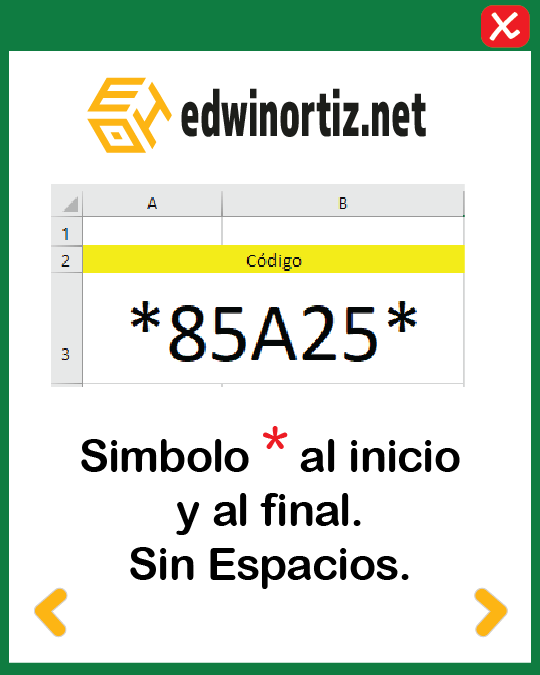
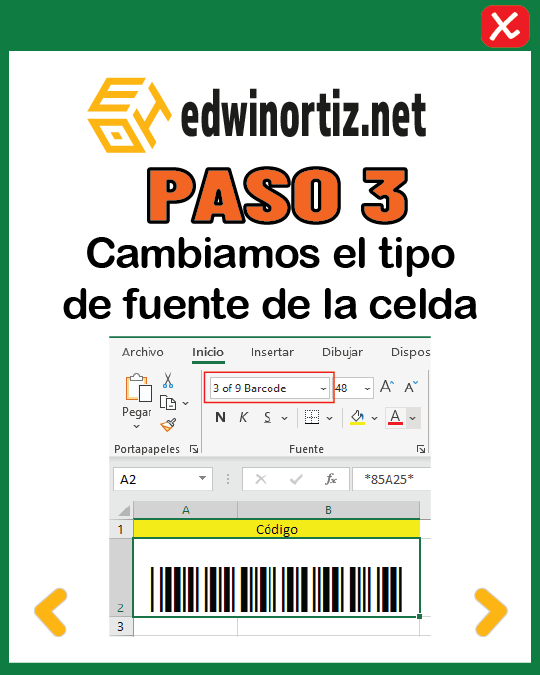
Steps to create barcodes in Excel

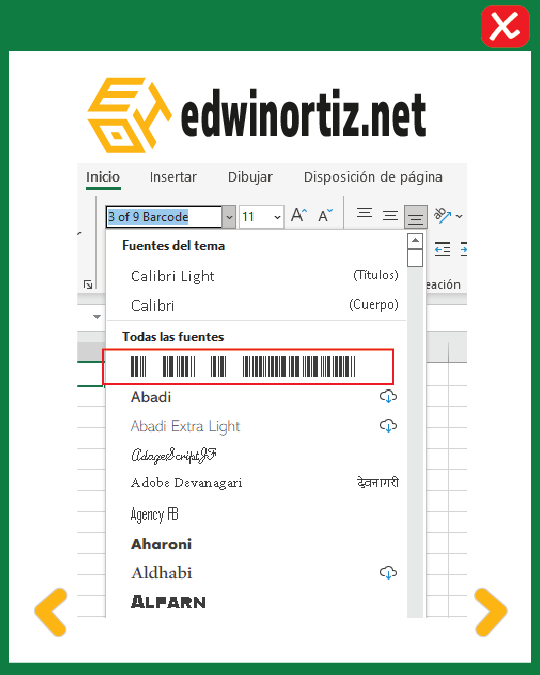
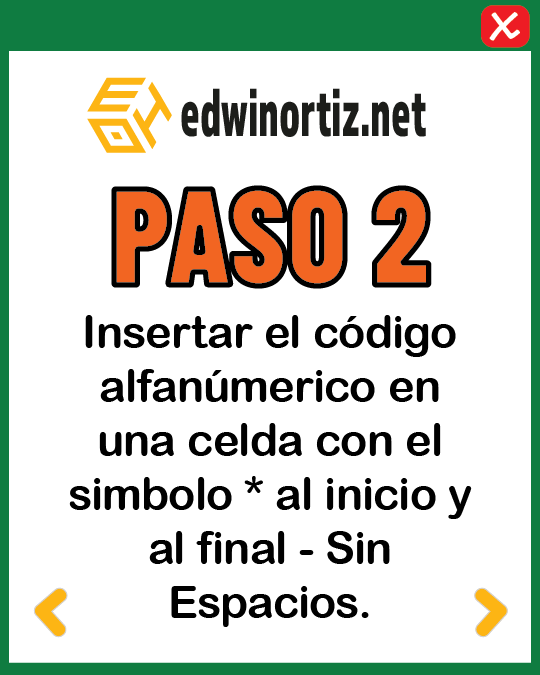
With these three simple steps we can create our company's barcodes and customise them to our needs.
Barcode characteristics
Code 39
Also known as Code 3 of 9, it is an alphanumeric, variable-length barcode. It lets you generate a barcode that includes numbers, capital letters and some special characters such as spaces, hyphens and slashes.
Code 128
It is a barcode similar to Code 3 of 9, with the difference that it includes a check digit (checksum) to make reading the code more reliable. Now called GS1-128 (formerly EAN 128), it can encode alphanumeric characters plus ASCII control characters such as CR, LF, etc. It is mainly used in logistics and parcel delivery (courier services).
EAN 8 / EAN 13
These are two types of numeric barcodes used in Europe (they do not accept letters). EAN stands for European Article Number, and their main use is to encode retail items (mainly the products you find in supermarkets).
Their length is fixed at 8 and 13 digits respectively, and the last digit is a check digit (checksum). In an EAN13 code, the first 3 digits identify the country of origin, the next four to five digits identify the manufacturer, and the remaining digits identify the product.
UPC
The UPC (Universal Product Code) is the counterpart of EAN 13, but used in the United States and Canada. It is numeric and is mainly used to encode products. There are two variants: UPC-A and UPC-E.
Examples of different barcodes

Prefer to have it ready?
More guides in Excel automation for office work